


Plating: rules and techniques for food service professionals
In short:
- Plating is a production step that must stay readable, repeatable and compatible with the pace of service.
- A focal point, an odd number of elements and roughly one third of empty space are enough to structure most plates.
- Contrasts in colour, texture and temperature make a dish more appealing than piling on garnishes.
- The choice of tableware (diameter, rim, colour, material) frames the dish as much as the chef's hand.
- For buffets, delivery and takeaway, plating must above all survive transport and waiting time.
Before the first bite, guests have already tasted with their eyes. Plating is the moment when cooking becomes visible: it conveys the chef's intention, showcases the produce and shapes the first impression. For professionals, though, the stakes go well beyond aesthetics. A beautiful plate has to leave the kitchen identical throughout service, without holding up the pass or compromising hygiene.
This guide brings together the rules of composition, the main presentation techniques and the organisational habits used by kitchen brigades. It also covers situations where food leaves the dining room (buffets, cocktail receptions, meal trays, takeaway) and how to choose the right serving ware for each use.

What plating really means in food service
A production step: readable, repeatable and compatible with service pace
In a professional kitchen, plating is not a fresh improvisation for every ticket. It is the final stage of production, just like cooking or seasoning. It has to meet three requirements:
- Readable: guests immediately identify the main ingredient and understand what they are about to eat.
- Repeatable: any cook on the section achieves the same result, from the first plate to the hundredth.
- Compatible with service pace: assembly fits within the time available at the pass, without letting the other plates on the table go cold.
A spectacular plating that takes three minutes per plate becomes a real problem on a table of twelve. True mastery means designing a presentation that still looks good when the brigade is under pressure.
How presentation changes the perception of a dish
Presentation does more than please the eye: it influences how a dish is appreciated. In a study published in the journal Flavour (Michel, Velasco, Gatti and Spence, 2014), the same ingredients were served in three different arrangements. The version composed like a Kandinsky painting was liked the most, and participants said they would be willing to pay more for it.
For a restaurant, the plate therefore sets expectations: price level, generosity, freshness and care for the produce. Be careful with the promise, however. A highly elaborate plate with average flavour disappoints more than a simple, well-executed dish. Plating serves the cooking; it never replaces it.
Composing the plate: hierarchy, placement and negative space
Define a focal point and rank the elements
Every successful plate starts with a simple question: what should the guest look at first? That focal point is usually the main ingredient (a cut of meat, a fish fillet, the star vegetable of a vegetarian dish). Garnishes then support it, while the sauce and finishing touches tie everything together.
In practice, stick to one star element and two or three supporting ones. Beyond that, the eye no longer knows where to rest and the plating becomes hard to reproduce.
Clock, rule of thirds, odd numbers: placement guides
Three visual guides help place elements without hesitation:
- The clock: in classic plating, the protein sits at 6 o'clock, facing the guest, the starch around 10 o'clock and the vegetables around 2 o'clock. This reference makes instructions easier to pass on within the brigade.
- The rule of thirds: mentally divide the plate into nine equal squares and place the focal point on one of the intersections rather than in the exact centre. The result looks more natural and dynamic.
- Odd numbers: three scallops or five dots of purée create a more harmonious composition than an even number, which the eye tends to split in half.
Let the plate breathe: the two-thirds rule
Empty space is part of the composition. A widespread rule is to fill only about two thirds of the usable surface and keep the rim perfectly clean. That empty space frames the dish, highlights the produce and signals care.
An overloaded plate looks like a canteen; an overly empty one may seem stingy. The right balance depends on the restaurant's positioning: a bistro embraces generosity, while a fine dining table plays more with negative space.
Building height without weakening the structure
Height adds relief and draws the eye, as long as it stays stable. Start with a base that anchors the whole (purée, risotto, a bed of vegetables), then add flat elements, and finish with the fragile ones. Beyond three layers, the build risks collapsing between the pass and the table.
Think about heat too: a tuile placed on a hot sauce softens within minutes. Crispy elements should therefore go on at the very last moment, just before the plate leaves.
Colours, textures, temperatures: working with contrast
A neutral base with accents of colour
Colours drive appetite. Most chefs start from a neutral base (a white plate, a main ingredient in natural tones) and add two or three accents: the green of a herb oil, the orange of a carrot purée, the red of beetroot. Complementary colours enhance each other, whereas a range of beiges quickly makes a plate look dull.
Edible flowers add a spectacular touch, but they should be used sparingly and sourced from a food supplier. Not all flowers are edible, and those sold by florists are often treated. One principle applies to all plating: nothing placed on the plate should be inedible.
Alternate crunchy, tender and creamy
Contrasting textures bring a dish to life on the palate as much as on the plate. A balanced plate usually combines:
- a crunchy element: tuile, crumble, toasted seeds, finely cut raw vegetables;
- a tender element: confit, low-temperature cooking, fish cooked just right;
- a creamy element: purée, emulsion, mounted sauce, cream.
This trio works as well for a bistro dish as for a fine dining plate. It avoids the monotony of an entirely soft dish, a common flaw of preparations made in advance.
Warm or chill the plate depending on the dish
A cold plate drops the temperature of a hot dish in seconds and sets the sauces. For hot dishes, plates go into a plate warmer or hot cupboard before service. For cold starters, carpaccios or frozen desserts, they are kept in the cold room instead.
This habit does not replace compliance with regulatory temperatures before plating. In France, the order of 21 December 2009 on health rules for retail food activities (arrêté du 21 décembre 2009) sets a minimum of +63 °C for cooked dishes intended to be eaten hot and a maximum of +3 °C for chilled cooked dishes.
The main plating techniques
Each technique creates a different visual effect and takes more or less time at the pass. The table below compares the main ones on these criteria.
| Technique | Visual effect | Suitable dishes | Speed at the pass |
|---|---|---|---|
| Centred, ring mould | Clean, structured | Tartares, risottos, stacked starters | Fast |
| Linear | Graphic, modern | Fish, tasting menus | Fast |
| Asymmetric | Natural, creative | Seasonal cooking, fine dining | Medium |
| Crown, rosette, fan | Generous, regular | Carpaccios, sliced meats, fruit | Slow |
| Quenelles, dots, swooshes | Precise, elegant | Desserts, sauces, purées | Medium |
The fastest techniques (centred, linear) suit high-volume services, while rosettes or asymmetric layouts are better reserved for short menus and tasting menus, where assembly time is built into the organisation.

Centred plating and ring mould plating
Centred plating places the main element in the middle of the plate, with garnishes around or on top. It is reassuring, easy to reproduce and suits tartares, risottos, composed salads or stacked starters. The stainless steel ring mould is its key tool: fill the ring, press lightly with the back of a spoon, then lift it straight up with a slow movement to keep clean edges.
Linear and asymmetric plating
Linear plating lines up the elements along a diagonal or horizontal line. Very graphic, it pairs well with rectangular plates and tasting menus. Asymmetric plating shifts the focal point to one side and leaves a wide empty area: it gives a natural, almost spontaneous look, but requires a reference photo to stay identical from one plate to the next.
Crown, rosette, fan
These repetitive layouts showcase sliced produce. Carpaccio is arranged in a rosette, slices of duck breast or pork tenderloin in a fan, turned vegetables or fruit in a crown around a central element. The result is generous and regular, but assembly takes longer: prepare the slices in advance, at a consistent thickness, to save time.
Quenelles, dots and sauce swooshes
A quenelle is shaped with two spoons, or with a single spoon dipped in hot water for ice creams and ganaches. Dots of sauce or purée are applied with a pipette or squeeze bottle, in graduated sizes to create movement. The swoosh is drawn in one continuous motion with the back of a spoon or a brush.
Go easy on the sauce. It is better placed under or beside the main element, or even poured at the table in front of the guest, than drowning a fish with crispy skin.
Last-minute finishing touches
Finishing touches give the dish its final shine: fresh shoots and herbs, flaky sea salt, a drizzle of oil, citrus zest, cracked pepper, seeds. They are placed with tweezers just before the plate leaves, so the herbs do not wilt under the heat. Each finishing touch needs a flavour reason: a sprig of chervil added for looks on a chocolate dessert muddles the message.
Adapting plating to the dish being served
Starters and amuse-bouches
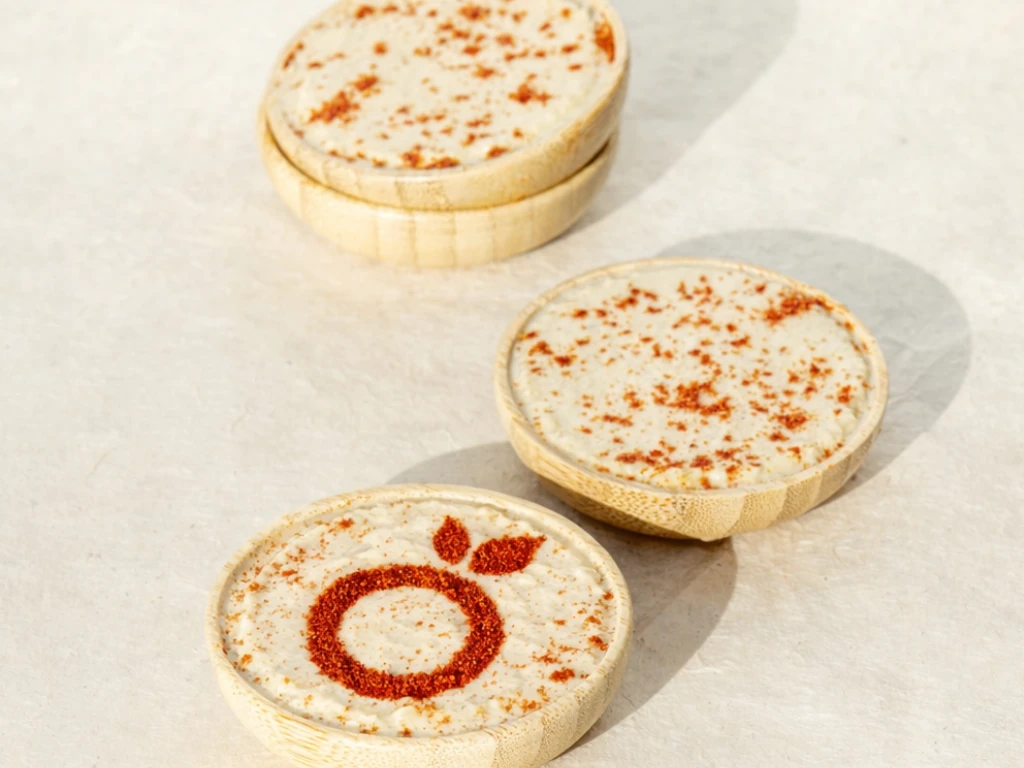
The starter opens the meal and sets the tone. It works well with centred layouts, modest height and bright colours. Amuse-bouches and appetisers are often served as individual portions in small bowls and ramekins, which frame one or two bites and can be plated quickly in batches on a tray.
Meat and fish
With meat, carving is part of the presentation: a piece sliced on the bias reveals the cooking and invites tasting. Let it rest before slicing so the juices do not spread across the plate. With fish, crispy skin faces up and the sauce goes underneath or around, never on top. Garnishes are arranged so they never hide the main ingredient.
Plated desserts
Plated desserts allow more graphic freedom, but they are very sensitive to temperature. Frozen elements (sorbet, ice cream) go on last, on a chilled plate, ideally on a crumble or shortbread that stops them from sliding. Sugar and chocolate decorations fear humidity: keep them dry and add them as the plate is sent.
Choosing the plate to suit the plating
Diameter, rim, depth: the format that frames the dish
The plate is the frame of the picture. The same dish looks generous on a 24 cm plate and almost minimalist on a 31 cm one. The rim matters too: a wide rim isolates the food and enhances the fine dining effect; a narrow rim or none at all leaves more surface for plating. Here are the most common formats in food service.
| Format | Indicative diameter | Recommended use |
|---|---|---|
| Large flat plate | 28 to 32 cm | Fine dining mains, plating with negative space |
| Standard flat plate | 24 to 27 cm | Starters, bistro or brasserie dishes |
| Deep plate or pasta bowl | 22 to 28 cm | Risottos, pasta, saucy dishes, soups |
| Dessert plate | 19 to 23 cm | Plated desserts, cheese |
| Rectangular or square plate | Variable | Linear plating, tasting menus, bites |
The format should therefore be chosen before plating, not after: it determines the visible portion, the empty space and the stability of the elements. Ranges of professional plates make it easy to harmonise these formats across the whole menu.

Colour, shape and material of the serving ware
The white plate remains the benchmark because it makes every colour stand out. Black enhances light-coloured foods (white fish, shellfish, dairy desserts) and glossy sauces. Natural tones and irregular shapes evoke rustic or seasonal cooking.
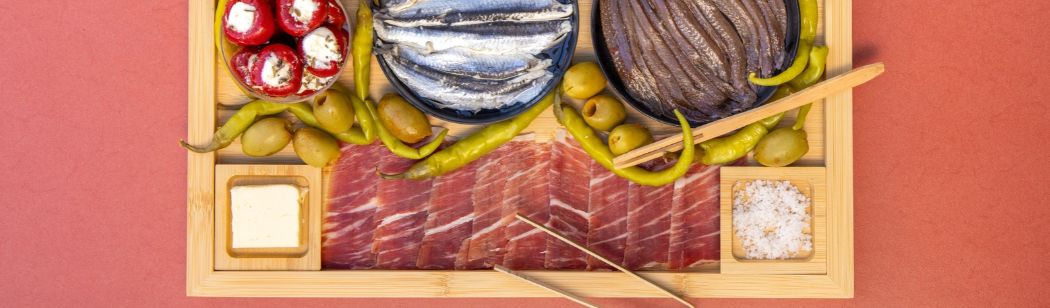
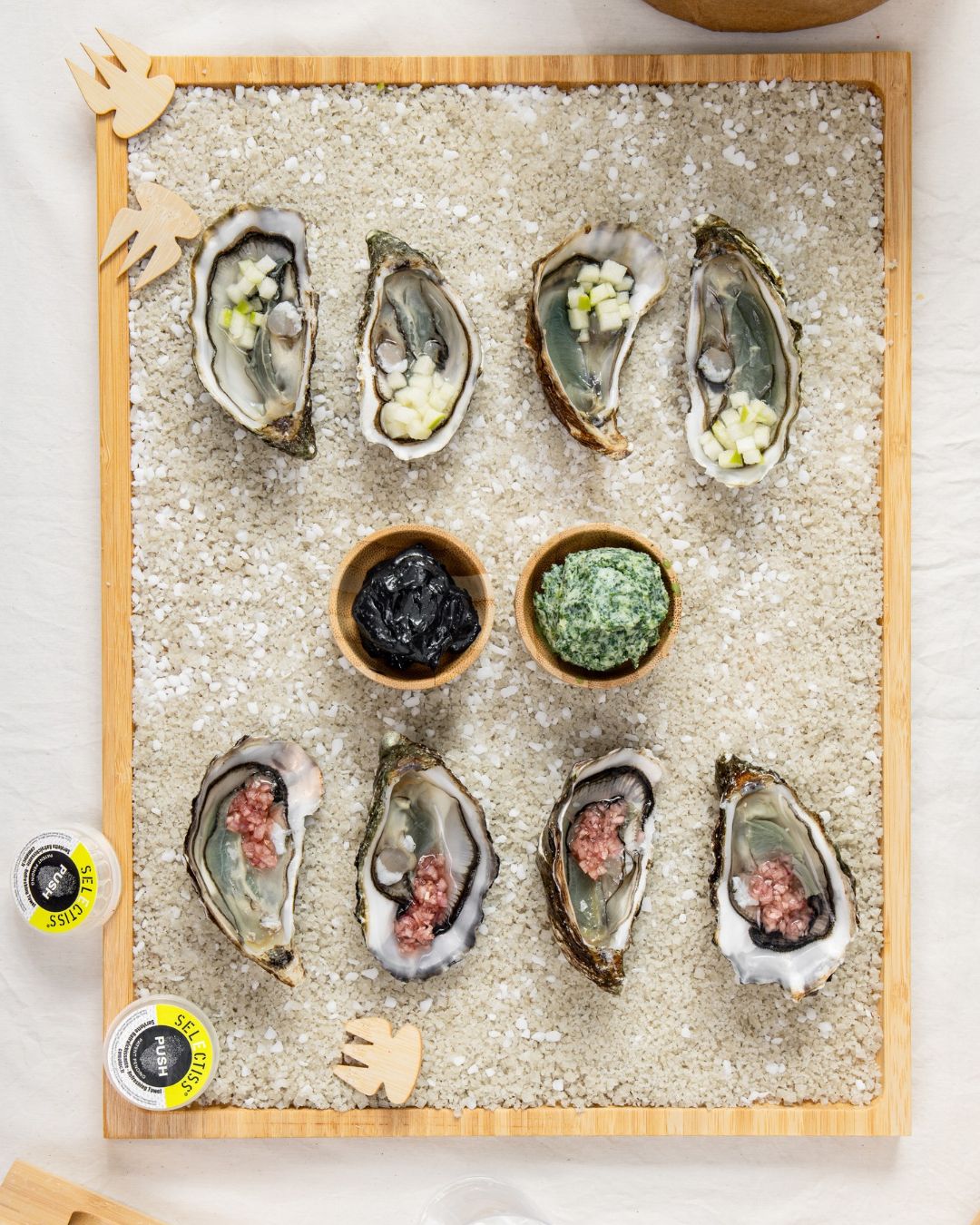
To move away from the white plate, especially for bistro service or sharing boards, wooden trays bring instant warmth. Gastronorm trays with a black slate-effect base or in bamboo offer a contemporary look while fitting the standard kitchen formats. Whatever the material, it must be suitable for food contact, as required by Regulation (EC) No 1935/2004 on materials intended to come into contact with food.
Keeping plating consistent during the rush
Mise en place and small plating tools
Fast plating starts long before service. Mise en place brings every ready-to-place element to the station: portioned garnishes, sauces in squeeze bottles, finishing touches cut and stored in stainless steel gastronorm pans arranged in assembly order. The essential small tools fit in a single drawer:
- rings and cutters in several diameters;
- straight and offset plating tweezers;
- quenelle spoons and saucing spoons;
- pipettes, squeeze bottles and brushes;
- offset spatula and palette knife;
- clean kitchen paper for wiping rims.
Set a standard: reference photo and assembly order
Every dish on the menu should have a plating spec sheet: a reference photo displayed at the pass, a numbered assembly order, portion weights, element positions on the clock and plate type. This standard secures service when a commis stands in for a section chef and makes training new recruits easier. It also serves as a basis for tracking food cost, since every garnish is quantified.
Final check: rims, smudges, hygiene
Before it leaves, the plate gets a final check: rim wiped with clean, slightly damp paper, no fingerprints or sauce splashes, elements correctly placed. Plating is done with tweezers or spoons rather than bare hands, in line with the principles set out in Regulation (EC) No 852/2004 on the hygiene of foodstuffs.
Finishing touches added at the last minute must also appear in the information given to guests. A hazelnut crumble or sesame oil contain allergens that must be declared under Regulation (EU) No 1169/2011 on the provision of food information to consumers, even when used only as decoration.
Mistakes that slow down the pass
- Adding decorative elements with no flavour purpose.
- Improvising a variation mid-service instead of following the spec sheet.
- Building too high on a dish that has a long way to travel to the table.
- Plating a hot dish on a cold plate, or a frozen dessert on a warm one.
- Searching for a utensil or garnish that is not within reach.
- Fixing a botched plate instead of starting again.
When plating leaves the dining room: buffets, cocktails, delivery
Bites, verrines, buffets: plating in batches
In catering, you no longer plate one dish but a hundred identical bites. An assembly line is essential: each person adds one element, from base to finish. Catering verrines are well suited to batch work, as their transparency shows the layers of colour and texture without any extra handling.
On a buffet, presentation is designed at table scale: alternating colours, grouping by product family, playing with levels. Wooden buffet displays add height and avoid the flat look of trays laid side by side. Choose preparations that can handle waiting: as service goes on, delicate leaves wilt, tuiles soften and sauces form a skin.
Meal trays and takeaway: plating that has to survive the journey
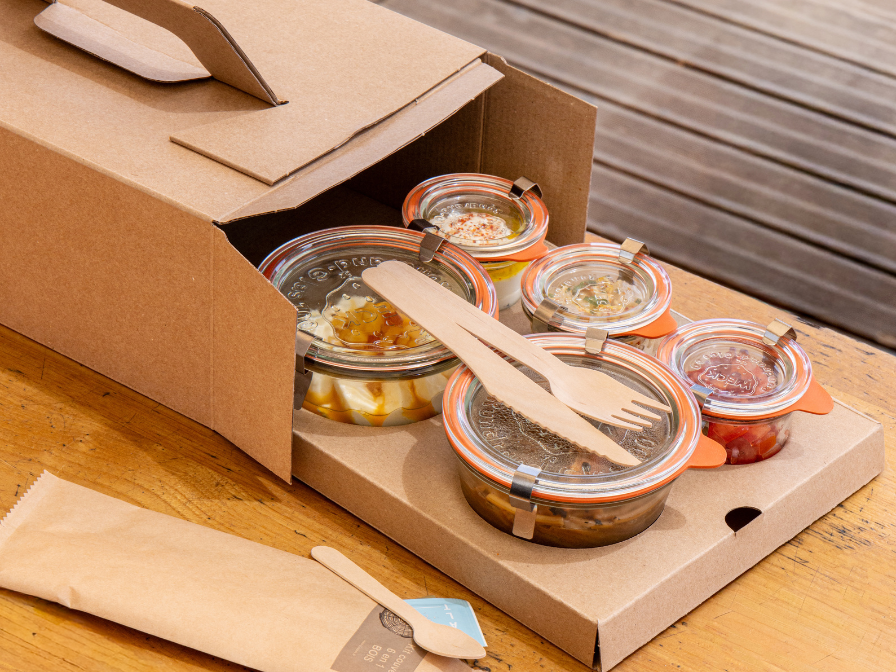
As soon as food travels, stability matters more than height. Cardboard meal trays with a base and insert hold containers in place and protect the plating all the way to the customer. A few simple rules limit the damage:
- keep sauces and crunchy elements separate, to be added just before eating;
- choose compartmentalised containers so juices do not mix;
- favour low, compact plating;
- put fragile finishing touches (herbs, seeds) in a small separate pot.
For takeaway, the clear lid becomes the dish's shop window: clean plating that reads at a glance reassures customers just as much as in the dining room.
Quick service dine-in: what reusable tableware changes for plating
In France, since 1 January 2023, the law No 2020-105 of 10 February 2020 on the fight against waste and the circular economy (AGEC law) requires quick service restaurants with at least 20 seats to serve dine-in meals on reusable tableware.
This change affects plating. Reusable containers are often more rigid, more colourful and sometimes deeper than disposable packaging. They allow a more polished result, closer to a plate, provided spec sheets are adapted to the new format and dishwasher durability is checked.
Finding your plating ware at Comatec
Good plating rests on a few constant principles: a clear focal point, empty space, contrasts of colour and texture, controlled temperature and a written standard the whole brigade can follow. The serving ware completes the gesture: plates, trays, verrines and delivery containers should be chosen to suit the dish, not the other way round.
Before renewing your tableware or catering containers, test them in real conditions. Comatec offers free samples so you can check how your plating looks, as well as a toolbox to help you choose your equipment. Photograph your signature dish, compare it with your reference sheet and ask yourself what a guest will remember at first glance: that is often where improvement begins.
Key takeaways
What are the basic rules of plating?
You need a focal point, an odd number of elements and about one third of free surface. Add contrasts of colour and texture, keep the rim clean and make sure every component on the plate is edible and contributes to the flavour of the dish.
What are the main plating techniques?
The main techniques are centred, ring mould, linear, asymmetric, rosette and fan plating. Saucing gestures such as quenelles, dots and swooshes complete them. The right choice depends on the ingredient, the serving ware and the time available at the pass.
How do you choose a plate for plating?
Choose the format according to portion size and the desired effect. A large diameter with a wide rim elevates a fine dining dish, while a deep plate suits saucy preparations. White is the most versatile option, and black makes light-coloured foods shine.
How do you keep plating consistent during service?
Write a plating spec sheet for every dish. It includes a reference photo, the assembly order, portion weights and the plate type. Displayed at the pass and combined with mise en place arranged in assembly order, it lets every cook achieve the same result.
Should plates be warmed before plating?
Yes, for every dish served hot. A warm plate keeps the sauce and garnish hot all the way to the table. Cold starters, carpaccios and frozen desserts need the opposite: a plate taken straight from the cold room just before assembly.
Are edible flowers safe to use?
Yes, provided they are bought from a food supplier. Ornamental flowers may have been treated with products unfit for consumption. Identify each variety precisely, keep them refrigerated and place them just before the plate leaves so they stay fresh.
Food plating: rules and techniques for professionals
In brief:
- Food plating is a production skill that must remain clear, consistent and compatible with the pace of service.
- A focal point, an odd number of components and approximately one-third empty space are enough to structure most fine-dining presentations.
- Contrasts in colour, texture and temperature make a dish more appetising than an accumulation of side dishes, while enhancing its aromas.
- Choosing the right serving dish (diameter, rim, colour and material) is just as important as the chef’s technique.
- For buffets, deliveries and takeaway services, presentation must above all withstand transport and waiting times.
Even before the first bite, the diner has already tasted the dish with their eyes. Plating is the moment when the cuisine becomes visible: it conveys the chef’s intention, showcases the ingredients, and shapes the first impression. For a professional, however, the stakes go beyond mere aesthetics. A beautiful presentation must remain consistent throughout the service, without slowing down the kitchen line or compromising hygiene, in order to preserve the dining experience.
This guide brings together the rules of composition, key presentation techniques, and organizational practices used in the kitchen. Finally, it addresses situations where the dish does not go directly to the dining room. Whether served as a buffet, delivered, or sold as takeout, the presentation must withstand waiting and transport, which alters both the preparation process and the serving vessel.
What food plating involves in the restaurant industry
A production skill: clear, consistent and compatible with the pace of service.
In a professional kitchen, plating is not an improvisation repeated with every order. It is the final stage of food preparation, just like cooking or seasoning. It must meet three requirements:
- Clear: Guests can immediately identify the main ingredient and understand what they are about to eat.
- Reproducible: Any chef working at the station can achieve the same result, whether it is the first or the hundredth plate.
- Compatible with service pace: Plating must fit within the time available at the pass, without allowing the other dishes on the table to get cold.
A plating technique that takes three minutes per serving quickly becomes unmanageable when serving a table of twelve. The challenge is not simply knowing how to do it, but being able to reproduce the exact same result when the kitchen brigade is under pressure.
Ce que la présentation change à la perception du plat
Presentation does more than simply please the eye: it influences how a dish is perceived and enjoyed. In a study published in the journal Flavour (Michel, Velasco, Gatti and Spence, 2014), the same ingredients were served in three different presentations. The version arranged in the style of a Kandinsky painting was the most highly appreciated, and participants said they would be willing to pay more to taste it.
For a restaurant, plating therefore sets expectations regarding quality, portion size, freshness and the care taken in preparing the dish. However, it is important to deliver on that promise. A beautifully presented plate paired with average flavour is more disappointing than a simple, well-executed dish. Presentation should enhance the food, not replace it.
Plating a dish: hierarchy, placement and negative space
Define a Focal Point and Establish a Hierarchy of Elements.
Every successful presentation starts with a simple question: what should the guest look at first? This focal point is usually the main ingredient (a cut of meat, a fish fillet or the star vegetable in a vegetarian dish). The side dishes then complement it, while the condiment and finishing touches bring everything together and enhance the flavours.
In practice, limit yourself to one star component and two or three different side dishes. Beyond that, the eye no longer knows where to focus, and the plating becomes difficult to reproduce consistently.
Clock Positioning, the Rule of Thirds and Odd Numbers: Key Plating Guidelines.
Three visual guidelines help position the components with confidence:
- The clock method: In the classic approach, the protein is placed at 6 o’clock, facing the guest, the starch at 10 o’clock and the vegetables at 2 o’clock. This visual reference makes it easier to communicate plating instructions across the kitchen brigade.
- The rule of thirds: Mentally divide the plate into nine equal sections and position the focal point at one of the intersections rather than directly in the centre. This creates a more natural and dynamic presentation.
- Odd numbers: Three scallops or five dots of purée create a more harmonious composition than an even number, which the eye tends to perceive as two separate groups.
Give the Plate Room to Breathe: The Two-Thirds Rule
Empty space is an integral part of the composition. A widely used guideline is to occupy only around two-thirds of the usable plate surface and keep the rim (the outer edge) perfectly clean. This empty space frames the dish, highlights the ingredients and creates an impression of attention to detail.
An overcrowded presentation can evoke a cafeteria-style meal, while a plate that is too empty may give the impression of poor value. The right balance depends on the restaurant's positioning: a bistro embraces generous portions, while a fine-dining restaurant makes greater use of negative space.
Build Height Without Compromising Stability.
Height adds dimension and draws the eye, provided the structure remains stable. Start with a base that anchors the composition (purée, risotto or a bed of vegetables), then add the flat components, followed by the more delicate ingredients. Beyond three layers, the arrangement risks collapsing between the pass and the table.
Also consider temperature: a tuile placed on hot sauce will soften within minutes. Crispy ingredients should therefore be added at the very last moment, just before the dish is sent out.
Colours, Textures and Temperatures: Creating Contrast
A Neutral Base with Pops of Colour
Colour is the first criterion by which a dish is judged, and the only one that can be appreciated from two metres away. Most chefs start with a neutral base (a white plate and a main ingredient in natural tones), then add two or three colour accents: the green of herb oil, the orange of carrot purée or the red of beetroot. Complementary colours enhance one another, whereas a monochromatic palette of beige tones can quickly make the overall presentation look dull.
Edible flowers create an immediate visual focal point, but they should be used sparingly and sourced from a food-grade supplier. Not all varieties are edible, and flowers sold by florists are often treated with chemicals. One principle applies to every presentation: nothing placed on the plate should be inedible.
Alternate Crunchy, Soft and Creamy Textures
The contrast in textures brings the dish to life both on the palate and visually. A well-balanced composition generally combines:
- A crunchy element: tuile, crumble, roasted seeds, finely chopped raw vegetables;
- A melt-in-your-mouth ingredient: candied produce, low-temperature cooking, pearly fish;
- A creamy touch: purée, emulsion, whipped sauce, cream.
This trio works just as well for a bistro dish as it does for a gourmet plate. It avoids the monotony of an entirely soft dish a common flaw in dishes prepared in advance.
Heat or chill the plate depending on the dish
A cold plate causes the temperature of a hot dish to drop in a matter of moments and causes sauces to set. For hot dishes, the plates are placed in a plate warmer or warming cabinet before service. For cold appetizers, carpaccios, or frozen desserts, however, they are placed in a cold room.
This practice does not exempt one from complying with regulatory temperature requirements prior to plating. The decree of December 21, 2009, regarding health regulations applicable to retail activities sets the minimum temperature at +63 °C for prepared dishes intended to be consumed hot and the maximum temperature at +3 °C for refrigerated dishes.
The Major Dressage Techniques
Each technique produces a different visual effect, reflects a particular culinary style, and takes more or less time to prepare. The table below compares the main techniques based on these criteria.
Technical | Visual rendering | Suitable dishes | Speed on the Pass |
Centered, cookie cutter | Clear, structured | Tartares, risottos, and layered appetizers | Fast |
Linear | Stylish, modern | Fish, tasting menu | Fast |
Asymmetrical | Natural, creative | Seasonal cuisine, fine dining | Average |
Crown, rosette, fan | Generous, consistent | Carpaccio, sliced meats, fruit | Lente |
Quenelles, dots, lines | Precise, elegant | Desserts, sauces, purees | Average |
The fastest techniques (centered, linear) are suitable for high-volume service, while the rosette or asymmetrical methods are better suited for short menus and tasting menus, where the time required for plating is factored into the organization.
Centered and cookie-cutter-style training
Centered plating places the main ingredient in the center of the plate, with the accompaniments arranged around or on top of it. It looks inviting, is easy to replicate, and works well for tartares, risottos, mixed salads, or layered appetizers. The cookie cutter (stainless steel ring) is the essential tool for this technique: fill the ring, press down lightly with the back of a spoon, then remove it vertically in one slow motion to maintain clean edges.
Linear and Asymmetric Dressage
Linear plating arranges the ingredients along a diagonal or a horizontal line. With its striking visual appeal, it works well with rectangular plates and tasting menus. Asymmetrical plating shifts the focal point to one side and leaves a large empty space: it creates a natural, almost spontaneous look, but requires a reference photo to ensure consistency from one serving to the next.
Crown, rosette,
fan
These repetitive plating techniques showcase sliced ingredients. Carpaccio is arranged in a rosette pattern, slices of duck breast or filet mignon in a fan shape, and turned vegetables or fruit in a circle around a central piece. The result is generous and uniform, but the plating takes longer: prepare the slices in advance, cutting them to a consistent thickness, to save time.
Sauces in Dots, Dashes, and Drops
A quenelle is formed using two spoons, or a single spoon dipped in hot water for ice creams and ganaches. Dots of sauce or purée are piped or drizzled using a pipette or bottle, in varying sizes to create movement. A line, or “swoosh,” is drawn in one continuous motion using the back of a spoon or a brush.
Use the sauce sparingly. It’s better to place it under or next to the dish or even pour it at the table in front of the guest than to drown a fish with a crispy skin.
Last-minute touches
The finishing touches add the final sparkle to the dish: fresh sprouts and herbs, fleur de sel, a drizzle of oil, zest, crushed pepper, and seeds. They are added with tongs just before serving to prevent the leaves from wilting in the heat. Each finishing touch must serve a flavor purpose. If you remove it and the dish loses nothing, then it was unnecessary.
Adapt the garnish to the dish being served
Appetizers and Starters
The appetizer kicks off the meal and sets the tone for the restaurant’s style. It lends itself well to centered plating, small portions, and vibrant colors. Appetizers and amuse-bouches are often served in individual portions in small bowls and ramekins, each holding one or two bites, and can be quickly arranged in a row on a tray.
Meat and Fish
When serving meat, the way it’s cut is part of the presentation: a piece sliced on the diagonal reveals the doneness and invites you to taste it. Let it rest before slicing to prevent the juices from spreading across the plate. When serving fish, the crispy skin should face up, and the sauce should be placed underneath or around it
never on top. Garnishes should be arranged so that they never obscure the main dish.
Plated Desserts
Plated desserts allow for more creativity, but they remain very sensitive to temperature. Chilled elements (sorbet, ice cream) are placed last, on a chilled plate, and preferably on top of a crumble or shortbread to prevent them from sliding. Sugar or chocolate decorations are sensitive to moisture: they should be kept dry and added just before serving.
Choose the plate based on how the dish is plated
Diameter, rim, depth: the shape that frames the dish
The plate is the frame of the picture. The same recipe can look generous on a 24 cm plate and almost minimalist on a 31 cm one. The rim also plays an important role: a wide rim frames the dish and enhances its fine-dining appeal, while a narrow rim or no rim at all leaves more surface area available for the composition.
Here are the most common plate formats used by foodservice professionals.
Plate Size
| Approximate Diameter | Recommended Use |
Large Plate. | 28 to 32 cm | Fine-Dining Main Course, Plated with Negative Space. |
Standard Plate | 24 to 27 cm | Starter, Bistro or Brasserie |
Deep Plate or Coupe Plate | 22 to 28 cm | Risottos, Pasta Dishes, Sauced Dishes and Soups. |
Dessert Plate | 19 to 23 cm | Plated Desserts and Cheese. |
Rectangular or Square Plate | Variable | Linear Presentation, Tasting Menus and Finger Food. |
The plate size should therefore be chosen before plating, not afterwards: it determines the visible portion size, the amount of negative space and the stability of the components. Professional tableware ranges make it possible to maintain consistent plate sizes and styles across the entire menu.
Colour, Shape and Material of the Plate
The white plate remains the industry standard because it brings out every colour and nuance. Black enhances light-coloured ingredients (white fish, shellfish and dairy-based desserts), as well as glossy sauces and toppings. Natural tones and irregular shapes evoke rustic or seasonal cuisine.
For an alternative to traditional white tableware, particularly in bistro-style service or for sharing platters, wooden serving boards add an immediate sense of warmth. Gastronorm trays with a black slate-effect base or made from bamboo offer a contemporary look while remaining compatible with standardised kitchen formats.
Whatever the serving surface, it must be suitable for food contact, as required by Regulation (EC) No. 1935/2004 on materials and articles intended to come into contact with food.
Maintaining Consistent Plating During the Rush.
Plating Mise en Place and Essential Tools
Fast plating starts long before service begins. Mise en place means having every component ready at the workstation: pre-portioned side dishes, sauces in squeeze bottles, prepared garnishes neatly arranged in stainless steel gastronorm containers and organised in the order they will be used.
All the essential small tools should be kept within easy reach in a dedicated drawer:
Pastry rings and cutters in various diameters;
Straight and angled plating tweezers;
Quenelle spoons and sauce spoons;
Pipettes, squeeze bottles and brushes;
Angled spatula and palette knife;
Clean paper towels for wiping plate edges.
Establishing a Standard: Reference Photo and Assembly Sequence
Every dish on the menu should have its own plating specification sheet, including a reference photo displayed at the pass, a numbered assembly sequence, ingredient weights, the position of each component using the clock-face method, and the type of plate to be used.
This standard ensures consistency during service when a commis chef steps in for a chef de partie. It also makes training new staff easier and helps guarantee a consistent dining experience.
It also provides a basis for monitoring food costs, since the quantity of each side dish is clearly specified.
Quality Check: Plate Edges, Smudges and Hygiene
Before a dish is sent out, it undergoes one final check: the rim is wiped clean with a slightly damp, clean paper towel, there are no fingerprints or sauce splashes, and all components are correctly positioned. Finishing touches should be applied using tweezers or a spoon rather than bare hands, in accordance with the principles set out in Regulation (EC) No. 852/2004 on the hygiene of foodstuffs.
Finishing ingredients added at the last moment must also be included in the information provided to the customer. A hazelnut crumble or sesame oil contains allergens that must be declared under Regulation (EU) No. 1169/2011 on the provision of food information to consumers, even when used solely for decoration.
Common Mistakes That Slow Down Service
- Adding too many decorative elements with no culinary purpose.
- Improvising a variation during service instead of following the plating specification.
- Building a dish too high when it has to travel a long distance to the table.
- Searching for a utensil or side dish that is not within easy reach.
- Trying to fix a poorly plated dish instead of starting again.
When plating goes beyond the dining room: buffets, cocktail receptions and deliveries.
Bites, Verrines and Buffets: Batch Plating
In catering, we no longer plate a single dish but rather a hundred identical bites. An assembly-line approach is essential: each person adds one element, from the base to the finishing touches. Catering verrines lend themselves well to this assembly-line process, as their transparency reveals the layers of colors and textures without any additional handling.
On a buffet, the presentation is designed on a table-wide scale: alternating colors, grouping by food category, and varying heights. Wooden buffet displays add height and prevent the look of trays simply laid flat. Opt for dishes that hold up well while waiting: as service progresses, delicate greens wilt, tuiles soften, and sauces form a crust.
Meal trays and takeout: Plating that must withstand transport
When food is being transported, stability takes precedence over height. Cardboard meal trays with a base and dividers keep the containers in place and preserve the presentation until the meal reaches the consumer.
A few simple rules help minimize messes:
- Separate sauces and crunchy ingredients, to be added just before eating;
- Choose compartmentalized containers to prevent juices from mixing;
- Opt for low, compact presentations;
- Place delicate garnishes (herbs, seeds) in a separate small container.
- For takeout, the clear lid serves as the meal’s showcase: a clean, visually appealing presentation that’s immediately recognizable at a glance, just as it would be in the dining room.
Find your training aids at Comatec
The tableware complements the chefs’ techniques and creativity: plates, trays, verrines, or takeout containers should be chosen based on the recipe, its ingredients, and its flavors not the other way around.
Before updating your tableware or catering containers, test them under real-world conditions. Comatec offers free samples to help you evaluate how your plating looks, as well as a toolkit to guide you in choosing materials or recipe ideas. Take a photo of your signature dish, compare it to your reference sheet, and ask yourself what a customer will notice at first glance that’s often where improvement begins.
FAQ
What are the basic rules of plate training?
You need a focal point, an odd number of components, and about one-third of the surface area left empty. Add contrasts in color and texture, keep the edges neat, and make sure each component you place remains edible and enhances the flavor of the recipe.
What are the main training techniques?
The main techniques include centered piping, cookie-cutter piping, linear piping, asymmetrical piping, rosette piping, and fan piping. In addition, there are decorating techniques such as quenelles, dots, and swooshes. The choice depends on the product, the base, and the time available at the serving station.
How do you choose a plate for plating?
Choose the size based on the portion size and the desired effect. A large diameter with a wide rim enhances a gourmet meal, while a soup plate is ideal for dishes with sauce. White remains the most versatile option, while black makes light-colored foods stand out.
How can you maintain a consistent grooming routine while on duty?
Create a preparation sheet for each recipe. It should include a reference photo, the assembly order, the quantities, and the type of plate. Displayed at the pass and paired with a workstation organized in the order of assembly, it ensures that everyone achieves the same result.
Should you warm the plates before plating?
Yes, for all dishes served hot. A warm plate keeps the sauce and side dishes warm until they reach the table. Cold appetizers, carpaccios, and frozen desserts require the opposite: a plate taken out of the cold storage just before plating.
Are edible flowers safe?
Yes, as long as you buy them from a food supplier. Ornamental flowers may have been treated with substances that are not safe for consumption. Identify each variety precisely, store them in a cool place, and arrange them just before shipping to ensure they stay fresh.