Custom cups: boosting your brand at events

Categories : Blog

Custom Cups: Showcase Your Brand at Every Event

At a trade show, a festival or a corporate party, every guest holds a drink for hours. Few communication media offer that kind of exposure. A custom cup turns a simple serving accessory into a showcase for your brand. The key is choosing the right material, the right artwork and the right ordering schedule.

Between printed paper cups, reusable models and other drink containers, there is no shortage of options. In France, regulations also govern on-site service. This guide takes you from file preparation to delivery, with practical advice for every type of event.

In a nutshell :

  • A cup is the branded item that stays in guests’ hands the longest at an event  and the only one that regularly features in attendees’ photos.
  • Printed cardboard cups are suitable for hot drinks and takeaway service, while reusable cups are ideal for bars and on-site service.
  • For on-site consumption, reusable tableware is mandatory whenever a service point can accommodate at least 20 people simultaneously: regulations take precedence over design.
  • Cardboard cups remain permitted, with plastic content capped at 8%, and the deadline for eliminating plastic has been postponed to 2030.
  • A vectorised logo, colour references and artwork adapted to the cup’s curved surface help avoid unnecessary back-and-forth with the printer.
  • Allow approximately three months between placing your order and delivery: lead time, rather than budget, is often the main limiting factor.

What a custom cup brings to an event

A classic promotional item, such as a pen or a tote bag, quickly ends up at the bottom of a bag. A cup stays in hand. It moves from one stand to the next, catches the eye of other attendees and appears in photos. For an organiser, it is a useful tool first and a brand medium second.

An area visible throughout the event

A guest refills their drink several times during an evening or a day at a trade show. Every time they visit the bar, they interact with your logo. Their neighbors see it, too. This repeated exposure carries more weight than a poster glimpsed just once at the entrance.

The cup is also a highly photographed item. Toasts, selfies, group photos: your design ends up on social media without any extra effort. A well-crafted design, accompanied by a short message or the event’s hashtag, extends visibility long after the doors close.

With a reusable cup, the effect lasts even longer. Many attendees take their cups home, especially when the design is unique to a specific edition. For loyal festivalgoers, it even becomes a collector’s item. Including the year can strengthen this connection to a specific edition.

A service guide for teams

Customization isn’t just about branding. It also helps with organization. A color-coding system makes it easy to distinguish at a glance:

  • Bars or service points (main bar, VIP area, outdoor refreshment stand);
  • Types of beverages (beer, soft drinks, wine, hot beverages);
  • Audiences (exhibitors, visitors, partners);
  • Serving sizes, to avoid pouring errors.

At the counter, this system speeds up service during peak hours. With a deposit system, it also simplifies the counting of returns by collection point. This gives your team a common reference point for guiding participants or customers.

Paper or reusable cups: two uses, two logistics systems

The choice of beverage depends on the occasion. Welcome coffee at a trade show, beer at a festival, an outdoor reception: each situation calls for a different type of container and, above all, a different behind-the-scenes setup.

Printed paper cups for hot drinks and takeout

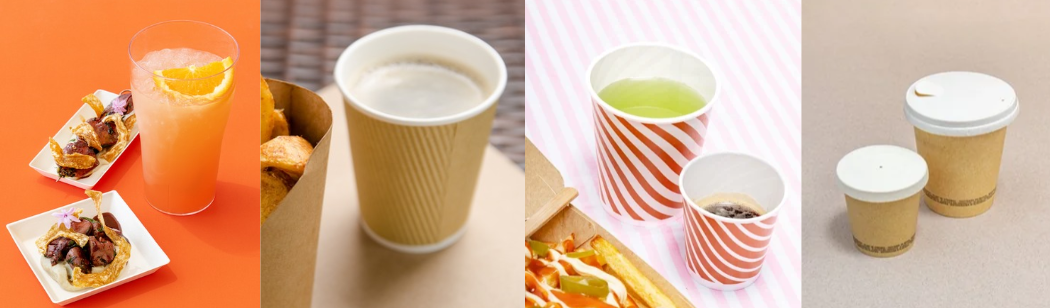
Paper cups remain the standard choice for coffee, tea, or hot chocolate served at the reception area of a seminar or at an exhibition booth. Their walls help limit the sensation of heat especially in the double-walled versionand they’re well-suited for takeout. The print covers the entire circumference, so there’s plenty of space for a logo, slogan, or illustration.

Logistically, paper cups are straightforward. No washing, no deposits, and they nest for space-saving storage. However, they are single-use products. To minimize their environmental impact, tailor quantities to actual needs and make post-use sorting easier by providing clearly marked collection points.

Reusable cups: deposit, washing, return

Reusable glasses and cups are suitable for cold beverages served on-site: beer, soft drinks, cocktails, or wine. They require a comprehensive logistics chain: a deposit system to encourage return, collection points, a washing solution on-site or through a service provider, and then clean storage until the next use.

To narrow down your choice, specify the beverages you plan to serve: a glass of water and a cocktail do not necessarily require the same capacity. If you’re looking for an “ecocup,” pay particular attention to the practical conditions for reuse: collection, washing, and the expected number of uses.

If the design isn’t dated, the same stock can be used for multiple events, which reduces waste and the cost per use. A dated design, on the other hand, encourages participants to keep the cups. This is a marketing trade-off that must be decided at the design stage.

The table below compares the two options based on the key criteria that matter most to event organisers.

Criterion

Printed paper cup

Reusable cup

Hot Beverages

Suitable, particularly for double-walled applications

Depending on the model, most are designed for cold weather

On-site consumption

Subject to the requirement to be reused in the relevant facilities

Meets the requirement for reuse

Logistics (inventory, laundry, return service)

Nested stock, no washing, no deposit required

Drop-off, collection, washing, drying, storage

Customization

All-around printing

Printing or marking, temporary or permanent graphics

Typical Use

Reception, coffee break, booth, takeout

Bar, refreshment stand, cocktails, on-site dining

In practice, many events combine both options: cardboard cups for hot drinks at reception and reusable cups for bar service.

Adapt the design to the type of event.

The same logo is not used in the same way at a trade fair as it is at a wedding. The tone, colours and prominence given to the message depend on the audience and the atmosphere being created.

Trade shows, seminars and corporate events.

In the corporate events industry, the cup extends your brand identity. A logo, corporate colours, website address or QR code linking to a dedicated page: a clean, understated design works best. At a trade show, a clear visual also helps visitors identify your stand as they walk through the aisles.

For internal events or product launches, there is more room for creativity: include the event name, date or a unique campaign tagline. Remember to test the QR code on a mock-up, as the curved surface of the cup may affect its readability. For Christmas events, a seasonal design can also complement your logo and add a festive touch to your end-of-year celebrations.

Festivals and public events.

At festivals, cups are often seen as an essential part of the event experience. Illustrations, event line-ups and partner logos all have their place. A new design for each edition makes the cup more appealing to keep, turning some unreturned deposit cups into cherished souvenirs.

Don't overlook bar accessories either. Straws and stirrers suited to cocktails and matching the event's colours complete the overall look without slowing down service.

Receptions and weddings catered by a professional caterer.

For a wedding, birthday or christening, personalisation becomes more intimate. Names, dates, a short message or a monogram can be incorporated into the design to complement the table decorations. For an outdoor drinks reception, caterers can offer cups as a practical alternative to champagne flutes and wine glasses, which are more prone to breakage. For a gathering with friends or family, a shared graphic detail can also reflect the theme of the celebration.

When ordering personalised cups for a wedding, choose a quantity based on the number of guests, allowing for a small extra margin. Guests often enjoy taking their cup home as a keepsake, and a few always tend to go missing by the end of the evening.

The key principle remains the same: a design tailored to your audience and a cup selected to suit the drinks being served.

Event Type

Recommended cup

Visual Elements

Trade show, seminar

Printed card at the reception desk, reusable at the bar

Logo, brand colors, QR code

Festival, public event

Reusable with a deposit

Publication visuals, programming, partners

Wedding, reception

Reusable or paper, depending on the service

First names, date, monogram

Preparing your customisation: design, artwork files, quantities and lead times.

A clear visual

The printing area is curved and small. Limit the number of elements: a logo, a short message, and perhaps a secondary note. Text that’s too thin and complex gradients lose sharpness. Aim for sharp contrasts between the background and the logo.

Customize your cup by focusing on one strong element rather than an accumulation of details. If you want to include a photo, check with the printer to ensure that its resolution and the printing technique will produce a legible result on the chosen design.

Take the lid into account. On cups and lids designed for takeout drinks, the top of the cup is partially hidden. Place the logo lower down so that it remains visible once the lid is on. Also make sure that the area held by the hand doesn’t cut off the main message.

Provide a usable file

The printer needs specific elements to ensure an accurate and faithful result:

  • A vectorised logo (AI, EPS, SVG or vector PDF), or, failing that, a high-resolution image.
  • The dimensions of the printing area, which vary depending on the cup model.
  • Colour references (Pantone or CMYK) taken from your brand guidelines.
  • Outlined fonts or font files supplied with the artwork.

Before production begins, you will receive a print proof (artwork approval) for review. Check it carefully, paying particular attention to spelling (especially names), dates and logo positioning. Once approved, this proof serves as the final reference for the entire production process.

Estimate the timeline and volume

Allow approximately 6 to 12 weeks between artwork approval and delivery, depending on the cup model and the time of year. Custom orders also require a minimum order quantity, which varies depending on the product. Arrange for a single delivery before the event setup to avoid running out of cups on the big day.

Before customising your cups, make sure to confirm stock availability for your chosen model and request a detailed quotation. Compare prices based on equivalent quantities and services, taking printing and delivery costs into account.

Let's look at a common scenario: Three weeks before a trade show, a company realises that its stand has no cups featuring its brand colours. There is no longer enough time for custom production. Alternative solutions, such as plain cups or stickers, are still possible, but the result will not be quite the same. To avoid this situation, include your cup order in your event planning schedule as soon as your space is booked, and submit your customisation request approximately three months before the event.

To estimate the required quantity, start with the expected number of attendees, multiply it by the average number of drinks per person, then add a safety margin. With reusable cups, fewer units are needed because they can be washed and reused throughout the event, provided the washing capacity keeps pace with the bar's service rate.
Regulatory Requirements for Customized Cups

The law is imposing increasingly strict regulations on single-use tableware. Before choosing your product, check the rules that apply to on-site service and the composition of paper cups.

On-site, reusable for groups of 20 or more people served at the same time

Effective January 1, 2023, Law No. 2020-105 on Waste Reduction and the Circular Economy (AGEC Law) requires food service establishments to serve meals and beverages consumed on-site in reusable tableware, provided they can serve at least 20 people simultaneously. The DGCCRF’s practical guide for cafés and restaurants details this requirement, which also applies to fast-food establishments.

Regarding the calculation of this threshold, a government response to a written inquiry specifies that both seated and standing customers are counted, whether indoors or outdoors. A refreshment stand or event bar may therefore be subject to this requirement, even if it does not have tables. If a service provider is handling the service, confirm the chosen solution with them before placing an order.

Paper cups: a cap on plastic content

Paper cups typically have a thin coating that makes them leak-proof. The decree of September 24, 2021, on the plastic content of cups sets a limit of 8% effective January 1, 2024. The next goal is to have plastic-free cups by January 1, 2030, a deadline that may be revised following a review scheduled for 2028.

In practice, ask your supplier to confirm that the model you’ve chosen complies with the regulations and keep the documentation on file. Paper cups remain fully suitable for takeout service, provided these limits are met.

Customized cups: Comatec's support

Comatec assists event organizers, caterers, and food service professionals in selecting and customizing their cups. The product line includes paper cups for hot and cold beverages, as well as reusable solutions for on-site service. For your custom cup projects, please specify the intended use, quantities, and event date when you submit your request.

  • Made in France, as indicated on the relevant product pages.
  • A wide selection of sizes to suit various uses and needs.
  • A dedicated contact person for your customization request.

To compare models, browse the catalogs. You can also request samples to test how they feel in the hand, the color rendering, and compatibility with lids before confirming your order. Get feedback from your service staff to ensure the model also meets their on-site requirements.

How to Create the Perfect Custom Cup for Your Event

When designed well, the cup becomes a discreet and effective branding tool, present from the first cup of coffee to the last drink. The key steps are as follows:

  • Define the use: hot or cold beverages, to-go or for consumption on-site;
  • Choose the material based on available logistics;
  • Adapt the design to the target audience and atmosphere;
  • Prepare a vector file with the correct color references;
  • Allow 6 to 12 weeks and plan for a single delivery;
  • Verify recycling requirements and the compliance of the cardboard.

The most common mistakes: a logo that’s too small, a lid omitted from the design, placing the order too late, or underestimating quantities. Avoiding these mistakes requires, above all, planning ahead. Set the date for your next event, then work backward on the timeline: it’s in your best interest to order your cups first.

FAQ

How much lead time should I allow when ordering custom cups?

Plan about three months in advance of your event. This timeframe covers the design process, proof approval, production, and shipping. Placing an order too late will limit your choice of designs and may force you to use plain cups without your logo.

Is a paper cup suitable for cold drinks?

Yes, provided you choose a model designed for that purpose. Single-wall paper cups are used for sodas, juices, and water. However, for on-site consumption at an establishment where cups are reused, you’ll need to switch to a washable option.

Are reusable cups required at events?

Yes, for on-site service when the venue can serve at least 20 people at the same time. Check with your caterer or bar manager in advance to find out what arrangements have been made and to adjust your cup order accordingly.

What file should I send for logo printing?

Envoyez un logo vectorisé au format AI, EPS, SVG ou PDF. Joignez les références Pantone ou CMJN de votre charte. Si vous ne disposez que d'une image, choisissez la meilleure résolution possible et jugez le rendu sur le BAT avant la production. 

Peut-on personnaliser des gobelets pour un mariage ou un anniversaire ?

Yes, first names, dates, and short messages print very clearly. Choose a legible font and no more than two colors for a crisp result. Order a few extra cups, since guests often take them home as souvenirs.