




Catering food transport: maintaining the cold chain during delivery
Transporting catered meals: maintaining the cold chain during delivery
A carefully prepared buffet in the kitchen can become a health risk after forty minutes of poorly managed transport. Catering food transportation is when the cold chain is most vulnerable: doors opening at every stop, an overheated car boot in summer, or trays left waiting at a company reception desk. Food safety regulations make no distinction between the cold storage room in a professional kitchen and the delivery vehicle. The required temperature remains the same, from the first to the last mile.
For caterers, restaurants offering delivery services, and food industry professionals providing meal trays, the challenge therefore goes beyond simply choosing the right packaging. They must select the appropriate vehicle according to the distance and the right container for each type of preparation. They must also organise the loading process and anticipate what happens once the food has been delivered to the customer.
This article explores the temperatures that must be maintained, the equipment suited to different delivery routes, the checks to be carried out, and the instructions to communicate to customers. It draws on the insulated bags and transport solution used daily by professionals. These solutions meet the needs of caterers and other takeaway food businesses, whether transporting a meal tray, a food box or cardboard packaging.
Key Takeaways:
Chilled preparations must be transported at a maximum temperature of +3°C, while hot dishes must be kept at a minimum of +63°C.
Hot and cold food must never be transported in the same container.
For journeys exceeding 80 km or involving a break in the transport chain, the vehicle must have an ATP certificate.
Properly secured containers and standardised sizes help minimise heat loss.
The cold chain must also be maintained at the customer's premises: waiting times, staggered serving and written instructions all play a role.
What catering delivery must ensure, from kitchen to customer
Regulation (EC) No 852/2004 on the hygiene of foodstuffs requires every food business operator to control hazards at each stage, transport included. In practice, the caterer's responsibility does not end at the kitchen door: it continues until the dish is handed over. The company's HACCP plan must therefore treat delivery as a control point in its own right, with its own temperature limits, checks and corrective actions.
Three objectives sum up what delivery must guarantee.
- Keep each dish at the right temperature.
- Protect food from contamination (dust, contact with other products, unnecessary handling). Preserve presentation, so the customer receives the dish exactly as it was plated.
- Food safety comes first, but an overturned tray or a crushed dessert is still a failed delivery.
Cook-chill and hot holding: two approaches that must never mix
With cook-chill, the dish is cooked, rapidly cooled, then stored and transported cold before being reheated on site if needed. With hot holding, it leaves the kitchen hot and must stay hot until service. Each method relies on different equipment, timings and checks.
The resulting rule is simple: never transport hot and cold food in the same container. A tray of gratin at +70 °C placed next to a mixed salad warms the salad and cools the gratin. Both products leave their safe zone. Within the same vehicle, each family of dishes travels in its own box, marked with a colour code or a hot or cold label to avoid mistakes during loading..
Temperatures to maintain during the journey
In France, the applicable thresholds are set by the order of 21 December 2009 on health rules for retail, storage and transport activities. The table below summarises the key values for a catering route.
The following table summarises the key figures for a catering route.
Type of preparation | Temperature | Reference text |
Pre-prepared food items (meal platters, salads, cream-based desserts) | +3 °C maximum | Decree of 21 December 2009 – Annex I |
Ready meals kept warm | +63 °C minimum | Decree of 21 December 2009 – Annex I |
Rapid cooling of hot preparations | A drop from +63 °C to +10 °C in less than 2 hours | Decree of 21 December 2009 – Annex IV, point 1 |
There is therefore little leeway: a chilled preparation that rises from +3 °C to +8 °C is already non-compliant. The range between +10 °C and +63 °C is where bacteria multiply most rapidly. This is why regulations require this range to be passed through in less than two hours during cooling, and why a dish must never remain within this range during delivery.
Vehicle, container, box: choosing food transport equipment for each route
There is no one-size-fits-all solution for food transport. A caterer delivering to three offices within a ten-kilometre radius does not have the same requirements as a caterer organising a cocktail reception for 300 people two hours’ drive away.
The distance, the duration of the route, the number of stops and the nature of the dishes determine the level of equipment required. Depending on the volume, a mobile trolley can be used alongside containers to move the food more easily to the serving area.
Insulated, refrigerated or cold-storage vehicle: what the distance dictates
Vehicles designed for transporting perishable goods fall into three categories, which are distinguished by their cooling capacity.
Equipment | Refrigeration | Typical use |
Isothermal vehicle | No, insulating panels only | Short runs with a box and batteries |
Refrigeration unit | Yes, a motorless cooling source (eutectic plates, dry ice) | Average journeys, consolidated deliveries |
Refrigeration unit | Yes, a refrigeration unit that regulates the temperature | Long distances, large volumes, events |
An insulated vehicle slows down heat exchange but never lowers the temperature: it preserves the existing temperature; it does not cool. Only refrigerated and mechanically refrigerated vehicles can compensate for heat entering the vehicle when the doors are opened.
Distance then plays a decisive role. For journeys under 80 km with no break in the transport chain, an ATP certificate is not required. However, the regulatory temperature must be maintained from departure to arrival, regardless of the means of transport used. For journeys exceeding 80 km, or whenever there is a break in the transport chain, the vehicle must hold an ATP certificate of compliance. The French Chamber of Agriculture's food transport guidance outlines these conditions and the associated requirements. In France, ATP certificates are issued by Cemafroid following an inspection of the vehicle.
The exemption for journeys under 80 km does not mean that no checks are required. A standard delivery van fitted with insulated containers may be suitable for an urban delivery route, provided that temperature records can demonstrate that the required limits have been maintained. During a food safety inspection, what matters is the result, not the type of vehicle used.
Insulated boxes for short delivery routes
For deliveries lasting just a few dozen minutes, insulated boxes are the most suitable solution. Combined with eutectic cooling plates frozen the day before, they can keep chilled food below +3°C throughout an urban delivery route, without requiring a refrigerated vehicle. Their advantage also lies in their portability: the box can be moved from the vehicle to the lift and then to the meeting room, without exposing the food to ambient air.
Compact, durable and available in several sizes, this mobile solution is ideal for catering delivery routes.
A few simple practices can help extend their effectiveness:
Pre-cool the empty box before placing the food inside.
Position the cooling plates above the food, as cold air naturally sinks.
Limit the number of times the box is opened during the delivery route.
Whenever possible, use one box per customer.
A box opened at every stop loses some of its cooling capacity each time. Using one box per delivery address solves this problem and makes unloading easier.
Stackable crates for the rest of the load
Not everything requires thermal protection. Tableware, tablecloths, non-refrigerated drinks and small serving equipment can easily be transported in stackable food-grade plastic crates.
Stackable and easy to clean, these crates free up space in insulated boxes for temperature-sensitive food products. They also help organise the load. A vehicle where every crate has its designated place can be loaded more quickly, unloaded without having to search for items, and reduces the amount of time the doors remain open.
They can be used to carry serving accessories, removable handles or stainless-steel equipment intended for buffets and events.
Catering packaging: the first line of defence against a break in the cold chain
The vehicle and the box maintain the temperature. The container, meanwhile, is in direct contact with the food. It is the container that protects the dish from knocks, cross-contamination and temperature fluctuations when the box is opened. Packaging that is not properly sealed allows hot air to enter, and a tray that slips will end up tipped over against the side of the box.
Secure, brace, stack: what the container must hold in place during transit
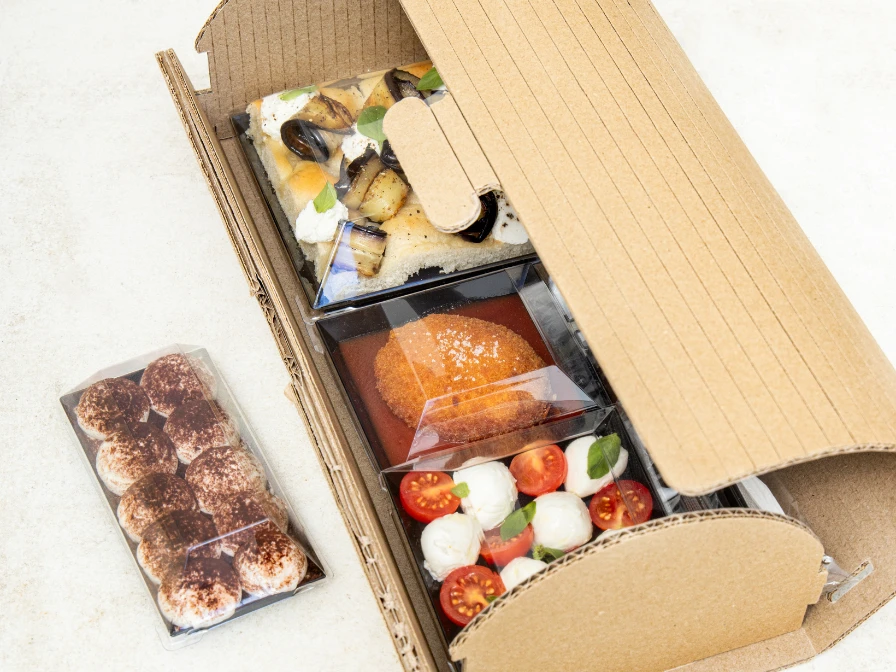
A good delivery container meets three requirements. It seals properly to keep the food fresh. It secures each component to prevent the starter from mixing with the dessert. It stacks without crushing the contents below. Cardboard meal trays with a base, internal divider and lid fulfil these three functions: each item stays in place and the lid allows several trays to be stacked inside the same box. A kraft cardboard box, when suitable for the product, complements this protection whilst ensuring a neat presentation.
For more upmarket services, meal boxes add a dimension of presentation without compromising stability during transport. In both cases, one key practice is essential: close the container in the kitchen, in the cold storage area, and not at the time of loading. Every minute spent open at room temperature is a minute taken away from the journey’s safety margin.
Atlas and Gastronorm sizes: fill the box without leaving any gaps
Air is the enemy of the cold chain inside an insulated box. The more empty space there is around the food, the faster the temperature rises each time the box is opened. Standardised formats help address this issue. Atlas trays are designed to be stackable and fit the surface area of delivery crates without wasting space. In the kitchen, gastronorm stainless steel containers follow the GN standard (GN 1/1: 530 × 325 mm), which most professional insulated boxes can accommodate directly. Durable and suitable for both cooking and storage, stainless steel therefore supports food service professionals at every stage, from kitchen preparation to delivery.
The benefits are twofold. Food prepared in a GN container can be transferred directly from the blast chiller to the insulated box without being transferred to another container, avoiding additional handling and heat loss. In addition, an insulated box filled with compatible containers maintains its temperature more effectively than one in which containers move around loosely. If there is still some space available, it is better to fill it with a cooling pack rather than a tea towel or paper.
Preparing for the food delivery round: loading, checking, cleaning
Three factors are key to maintaining the cold chain during transit: the order in which goods are loaded, temperature monitoring and the condition of the equipment.
Post in the reverse order of deliveries
The first customer to be delivered to must be the last one to be loaded. This rule avoids having to move all the boxes to reach the ones at the back, with the doors left open for long periods. It requires a delivery route to be planned in advance, specifying the order of stops and the location of each box inside the vehicle. Loading must take place at the last possible moment, in a pre-cooled vehicle if it is refrigerated, and never in direct sunlight on a pavement.
Check the temperature at the start and at the finish
The probe thermometer is the basic essential tool. It is inserted into the centre of a sample product, after disinfecting the probe between measurements. A temperature check before departure confirms that the meals left the kitchen in compliance with the required standards. A check upon arrival confirms that the cold chain has been maintained.
To be useful in the event of an inspection or dispute, each temperature record must include:
- The date and time of the measurement;
- The product checked and the customer concerned;
- The temperature recorded;
- The name of the person who took the measurement;
- Any corrective action taken if the temperature exceeds the permitted threshold.
For long delivery routes or refrigerated vehicles, an automatic temperature data logger records temperature variations throughout the entire journey. It reveals temperature fluctuations that two isolated measurements might miss, such as a sudden rise in temperature during a prolonged stop.
Clean and disinfect equipment before each round
A box that transported fish the previous day without being properly cleaned becomes a source of contamination. Boxes, containers, eutectic cooling plates and the vehicle's cargo compartment must be cleaned and then disinfected using a food-safe cleaning product before each delivery run.
Lid seals require particular attention: they can trap food residues and, if damaged, allow heat to enter.
A written cleaning schedule, incorporated into the HACCP system, specifies who cleans what, which products are used and how frequently cleaning must be carried out.
The final link in the catering food delivery process: from the truck door to the buffet.
Many breaks in the cold chain do not occur during transportation, but after delivery. The caterer has done their job, the food has arrived at the correct temperature, and what happens next at the delivery location is what really matters.
On-site waiting time: the blind spot in the delivery process.
Let's consider a common scenario. A caterer delivers twenty meal trays to the reception desk of a company at 9 a.m. for a lunch service scheduled at 12:30 p.m. The company does not have a refrigerator large enough to store them. The meal trays are left in their bags on a counter in a heated reception area. By lunchtime, they have been out of refrigeration for more than three hours. The fresh vegetable salad and chocolate mousse are no longer anything like the products that left the kitchen.
The delivery run was flawless, yet the customer ends up eating food that does not meet the required standards.
Several solutions are available: reschedule the delivery as close as possible to serving time, leave the meal trays in an insulated box with ice packs (to be collected during a later visit), or check at the time of ordering whether the customer has sufficient refrigerated storage space.
Asking the question right from the quotation stage can prevent many problems.
Bring the dishes out in batches, not all at once.
At a buffet, there is a strong temptation to set everything up as soon as the delivery arrives so that the table looks attractive. The result is that the first dishes sit at room temperature for an hour before the first guest serves themselves.
For buffets and receptions, it is better to bring the food out in batches and keep the backup supplies in closed insulated boxes until they are needed to replace a dish that has been partially served. This approach improves buffet presentation and the guests' overall experience without compromising food quality.
A common misunderstanding concerns transport bags. Although convenient for carrying a tray from the vehicle to an office, they do not keep food cold. Leaving a tray in a paper bag for two hours is essentially the same as leaving it on a table.
A bag is for carrying; an insulated box is for keeping food at the right temperature.
Provide the customer with written instructions.
A label or information sheet accompanying the delivery clearly establishes the customer's responsibility and guides them on the correct handling procedures. It specifies the delivery time, the storage instructions (refrigerate at a maximum of +3°C for cold preparations), the use-by date and, for dishes that need reheating, the recommended reheating method.
These instructions help protect consumers and provide evidence of good practice in the event of a complaint.
Why choose Comatec to equip your catering delivery operations?
Equipping a delivery operation means bringing together components that need to work seamlessly: containers, insulated boxes, trays and bags. Comatec offers a complete range of products for caterers and food service professionals, with particular attention to two key aspects.
The country of origin of each product, whether France or elsewhere in Europe, is clearly indicated, making traceability easier and helping customers choose locally manufactured products. Atlas and Gastronorm sizes are compatible across containers and insulated boxes, allowing every crate to be filled efficiently without wasting space.
A carefully selected range of products is available to help you put together consistent solutions, from presentation trays to transport containers, with or without handles depending on your needs.
Before placing an order, our payment and delivery terms provide clear information about lead times and conditions. For specific requirements or advice on configuring your delivery setup, simply get in touch with us.
Transporting catered meals: key points to bear in mind
Maintaining the cold chain during delivery comes down to a few clear rules: a maximum of +3°C for chilled food, a minimum of +63°C for hot food, never transporting both in the same container, using a vehicle suited to the journey distance, and keeping written temperature records both before departure and upon arrival. Properly sealed containers, standardised sizes and insulated boxes filled without empty spaces take care of the rest during transit.
One final link in the chain often gets overlooked: the waiting time at the customer's premises. This is where the difference between a compliant delivery and a truly safe meal is made.
The best place to start? Review your next delivery route step by step, from loading to buffet setup, and identify when your dishes spend the longest time outside refrigerated storage.
FAQ
Can hot and cold dishes be delivered in the same vehicle?
Yes, provided that each type of food is transported in a dedicated insulated container. The vehicle can be shared, but the insulated boxes cannot. Clearly visible labels on each crate help prevent handling errors at successive delivery stops and protect both types of food preparations.
What temperature should meal trays be delivered at?
At a maximum of +3°C, measured at the core of the food. Meal trays are prepared in advance and must be kept at or below this temperature from the moment they leave the cold storage room until delivery. They must then be stored in the customer's refrigerator until serving time.
Does a caterer need an ATP certificate?
No, not for journeys of less than 80 km without any transfer of goods. An ATP certificate becomes mandatory for journeys exceeding this distance or when goods are transferred between vehicles. In all cases, compliance with the required temperature regulations must be demonstrable.
Does a transport bag keep food cold?
No, a paper or fabric bag is only designed for carrying food. To maintain the correct temperature, you need a closed insulated box with ice packs, or the food must be placed in a refrigerator as soon as it is received by the customer.
Which thermometer should be used to check a food delivery?
A food probe thermometer that is regularly checked and calibrated. It measures the core temperature of a sample product. For long delivery routes, an automatic data logger placed inside the insulated box or the vehicle's cargo compartment provides continuous temperature monitoring throughout the journey.