Wooden, bamboo or stainless steel cutlery: which is right for your business?
Wooden, bamboo or stainless steel cutlery: which is the right choice for your establishment?
In brief:
Wood is suitable for occasional service but remains, in practice, a single-use cutlery option.
Bamboo can be reused provided it is hand-washed, which adds to the workload in the kitchen.
Stainless steel is the only one of the three materials that can withstand professional dishwashing, cycle after cycle.
For dine-in service, reusable tableware is mandatory when 20 or more people are served at the same time.
A knife that bends when cutting, a spoon that swells after just two washes, a cutlery tray that gradually deteriorates with every service: choosing cutlery may seem like a minor detail until it becomes a problem.
For a restaurant, catering business or snack bar, the choice of material is about more than just taste. It affects kitchen operations, costs, the image you project to customers and compliance with regulations.
Each material is suited to a specific purpose. Wood is ideal for occasional service, bamboo offers a middle-ground solution, while stainless steel is the go-to choice when cutlery needs to go through the dishwasher.
This guide explores their strengths, limitations and the regulations governing their use, before providing a selection guide tailored to your type of service: dine-in, takeaway or events. The goal is to help you choose a range of utensils suited to every dining occasion, without compromising service quality or overlooking maintenance requirements.
Wooden Cutlery: Ideal for Occasional Use
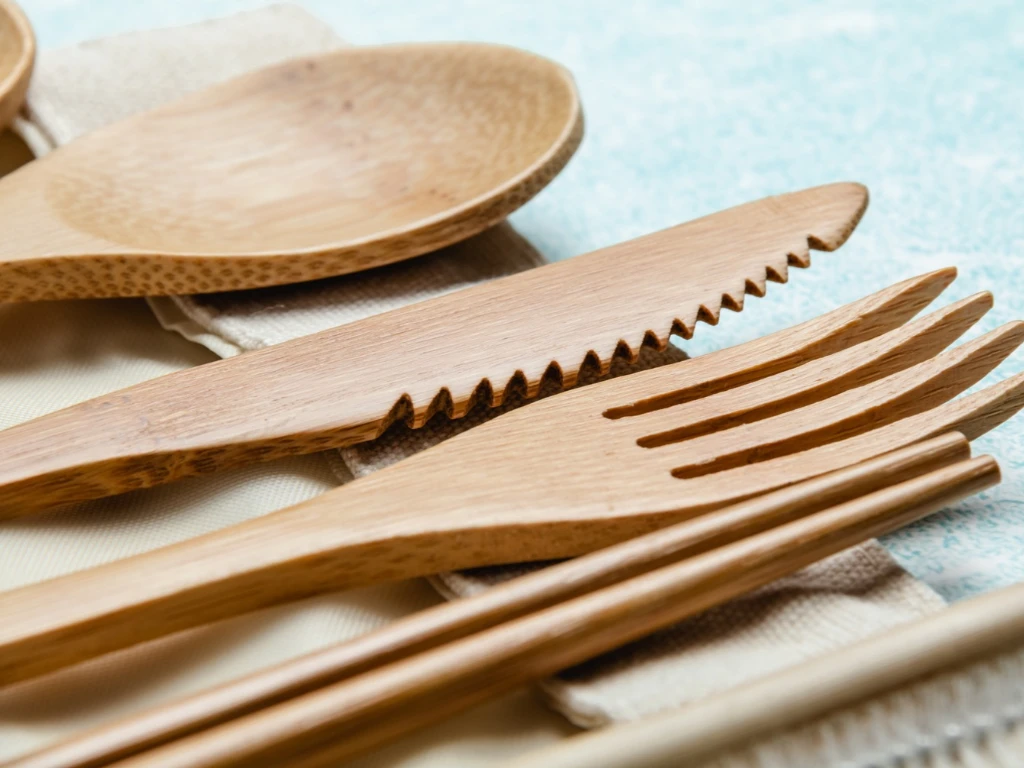
Lightweight, affordable and plastic-free, wood has become the go-to alternative to traditional disposable plastic cutlery. It is widely used in food trucks, bakeries, takeaway counters and at various buffet events. From meal trays to takeaway salads, a single range can include knives, forks and spoons to suit a variety of dishes.
Wood: Rigidity and Grip
Most wooden cutlery is made from birch, a light-coloured wood with no smell or taste that is easy to work into thin sheets.
Wooden cutlery is cut from a sheet of wood veneer and then shaped. Its thickness therefore varies considerably from one product to another, and this is what determines how well it holds up under pressure. This specification is rarely listed on product sheets, making it the first thing to check when testing a sample.
Imagine a buffet where grilled meat is being served. A guest presses down on their knife, the blade bends and then splits. They end up cutting with their fork or giving up on their meal. This kind of incident is far from uncommon and can leave a lasting impression on the customer experience.
Here are a few tips to help you avoid this situation and assess the quality of your utensils:
- Choose thicker knives for cutting meat and crunchy vegetables.
- Opt for a length of around 16 cm for a full meal, keeping shorter formats for desserts and tastings.
- Check the finish of the edges: well-sanded cutlery should be free of splinters and comfortable to use.
- Test a sample with your most demanding dish before placing a large order.
Single-Use in Practice
Wood is a porous material. When exposed to hot water and detergents, it absorbs moisture, swells, cracks and can trap food residues within its fibres. Thin wooden cutlery is therefore not designed to be washed and reused. In practice, it remains a single-use option. The natural appearance of a wooden spoon or fork is no guarantee of long-term durability.
This has a direct impact on how it can be used: wooden cutlery is suitable for situations where disposable tableware is still permitted, such as takeaway and delivery, but not for dine-in service in establishments subject to reusable tableware requirements (more on this below).
At the end of its life, check with your local authority, as sorting and food waste collection guidelines vary from one municipality to another.
Bamboo: Between Single-Use and Reusable Cutlery
Natural Bamboo or Varnished Bamboo: What Changes When Washing
Natural bamboo cutlery retains the authentic look of raw bamboo. Denser than birch, it offers a better grip and a more premium feel. However, it remains sensitive to water: prolonged soaking can cause it to swell and lose its natural appearance.
Varnished or oiled bamboo is treated with a finish that partially seals the fibres. Its surface is smoother, easier to clean and more resistant to stains. However, this protective coating does not make bamboo suitable for professional dishwashing. High temperatures, repeated washing cycles and alkaline detergents will eventually damage the varnish, exposing the inner material to deterioration.
Hand Washing: What It Means for Kitchen Operations
Reusable bamboo cutlery must be washed by hand in lukewarm water and dried immediately afterwards. On paper, the instructions are simple. In a professional kitchen, however, they add to the operational workload:
- A dedicated washing station, separate from the dishwasher circuit;
- Additional staff time at every service, on top of the usual dishwashing workload;
- Thorough drying before storage to prevent mould growth;
- Regular visual inspections to remove any cracked or damaged pieces.
For a café serving a few dozen desserts a day, this system remains manageable. For an 80-seat restaurant running two services, it creates a second washing process that is difficult to maintain during the busiest periods.
Reusable bamboo therefore works well for smaller volumes, tasting areas or food service concepts where aesthetics take priority over speed and volume.
The design of your cutlery range must therefore go hand in hand with practical maintenance requirements, from small coffee spoons to full-size dining cutlery.
Stainless Steel: Cutlery That Goes Straight into the Dishwasher
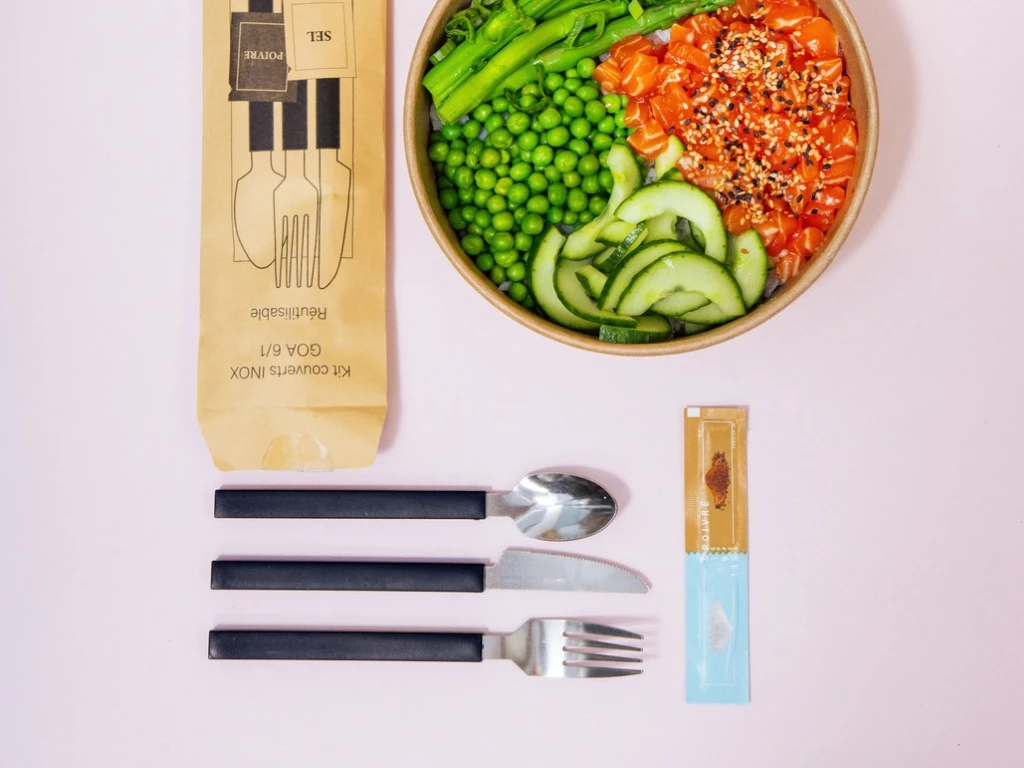
Stainless steel remains the benchmark material in traditional food service. It withstands high-temperature dishwasher cycles, does not retain odours and is easy to sanitise. It is also the heaviest of the three materials, which enhances customers' perception of quality.
For a cutlery range designed for dine-in service, this durability really pays off over time, withstanding repeated use day after day.
18/10 or 18/0 Stainless Steel: What Do the Numbers Mean?
Technical specifications for stainless steel cutlery often feature two numbers. These indicate the composition of the alloy: the first represents the percentage of chromium, while the second indicates the percentage of nickel.
- 18/10: 18% chromium and 10% nickel. Nickel provides better corrosion resistance and a long-lasting shine. This is the preferred choice for premium table settings.
- 18/0: 18% chromium and no nickel. This type of steel is more affordable and magnetic, but slightly more prone to staining if not dried properly. It is well suited to institutional catering and high-turnover food service.
The magnetic properties of 18/0 stainless steel offer a practical advantage: magnetic cutlery collectors can be installed near waste bins to prevent cutlery from being accidentally thrown away with leftover food from meal trays.
Turnover, Losses and Stock Management: The True Cost of Stainless Steel Cutlery
The unit price of stainless steel cutlery is significantly higher than that of disposable alternatives, but the investment pays for itself over hundreds of washing cycles. The real expense lies elsewhere: losses.
Take a reception with 150 guests. Cutlery is sent out to the dining area in full containers, then returns to the dishwashing area only half-full. Some pieces have been thrown away with the paper dessert plates, others have ended up in guests' bags, while a few have slipped under tablecloths. If nobody counts the cutlery before and after the event, these losses go unnoticed until the next service, when forks start running short. A spoon left behind on a tray or mixed in with food packaging is a typical example of this risk.
To ensure stainless steel remains a cost-effective investment in the long run, a few good practices are essential:
- Maintain a buffer stock, usually two to three sets per seat, depending on dishwashing turnaround times.
- Count cutlery before and after every off-site event to keep track of losses.
- Install magnetic cutlery collectors if you use 18/0 stainless steel.
- Carry out monthly stock checks and record discrepancies to identify which services generate the most losses.
Wood, Bamboo or Stainless Steel: A Comparison
To highlight the differences, here is a comparison of the three materials based on the criteria that matter most in everyday food service.
Critère | Bois | Bambou | Inox |
Usage type | Service ponctuel, vente à emporter, buffet | Usage court ou réutilisation en petits volumes | Service en salle, restauration collective, réception assise |
Lavage | Non prévu | À la main, eau tiède, séchage immédiat | Lave-vaisselle et plonge |
Passage en plonge professionnelle | Non | Non | Oui, cycle après cycle |
Poids et ressenti en bouche | Très léger, texture sèche | Léger, surface lisse et chaleureuse | Lourd, contact froid et neutre |
Image renvoyée au client | Pratique, naturelle, éphémère | Naturelle et soignée | Classique et qualitative |
Only stainless steel can withstand the demands of high-volume professional dishwashing. Wood and bamboo are not direct alternatives; they serve different purposes, particularly where tableware is not returned to the kitchen for washing.
What the Regulations Require
Before comparing materials in terms of appearance or price, it is important to consider what the law requires. In many cases, regulations make the decision for you.
Dine-In Service: Reusable Cutlery Required When Serving 20 or More People at the Same Time
Since 1 January 2023, France's Anti-Waste and Circular Economy Act (known as the AGEC Law) has required food service establishments to use reusable tableware for meals and drinks consumed on the premises, including cutlery. This requirement applies to establishments with the capacity to serve at least 20 people at the same time, as outlined in the French Competition, Consumer Affairs and Fraud Control Directorate (DGCCRF) guidance for cafés and restaurants.
The 20-person threshold often raises questions. The French government's response to a written question from the National Assembly clarifies that it includes both seated and standing customers, indoors and outdoors. Terraces and counters therefore count towards the total capacity, alongside indoor seating.
Any establishment reaching this threshold must use washable cutlery for dine-in service, which in practice means opting for reusable materials such as stainless steel.
Disposable Cutlery: Bio-Based Plastics Are Also Affected
Directive (EU) 2019/904 on single-use plastics prohibits the placing on the market of single-use plastic cutlery (forks, knives, spoons and chopsticks). The legislation defines plastic broadly: bio-based polymers and materials marketed as biodegradable are also covered. Only natural polymers that have not been chemically modified are excluded.
In other words, cutlery made from PLA or modified starch, even when marketed as compostable, is not a legally permitted alternative to conventional plastic cutlery. For single-use applications, businesses must turn to plastic-free materials such as wood, solid bamboo, paper or cardboard without a plastic coating.
Bamboo and Plastic: A Combination Not Permitted for Food Contact
Some utensils are labelled as being made from "bamboo fibres", when in fact they combine bamboo powder with a plastic resin, often melamine. The French Competition, Consumer Affairs and Fraud Control Directorate (DGCCRF) warns that these products are non-compliant: bamboo is not listed among the authorised substances for plastics intended to come into contact with food under Regulation (EU) No 10/2011.
These composite materials can also release melamine and formaldehyde, particularly when exposed to heat.
The right approach: ask your supplier for the exact material composition and the declaration of compliance. Genuine bamboo cutlery should be made from solid bamboo, never from a composite material.
Choosing the right cutlery for your service: dine-in, takeaway or events
Once regulatory requirements have been taken into account, the choice comes down to your actual service needs. Three situations are particularly common. The type of meal, how it is presented on a tray and whether food packaging is used all play a part in determining the most suitable option.
Dine-in service: plan for turnover and dishwashing
If you offer dine-in service and reach the 20-person threshold, the decision is clear: you need reusable cutlery that can withstand professional dishwasher cycles.
18/10 stainless steel is ideal for establishments that prioritise presentation, while 18/0 is better suited to high-volume food service.
Calculate your stock requirements based on the number of seats, the number of services and your dishwasher capacity, rather than simply on the menu.
Takeaway and delivery
For takeaway and delivery, single-use cutlery is still permitted, provided it contains no plastic. Wood is the most economical option, while bamboo adds a more premium touch to your offering.
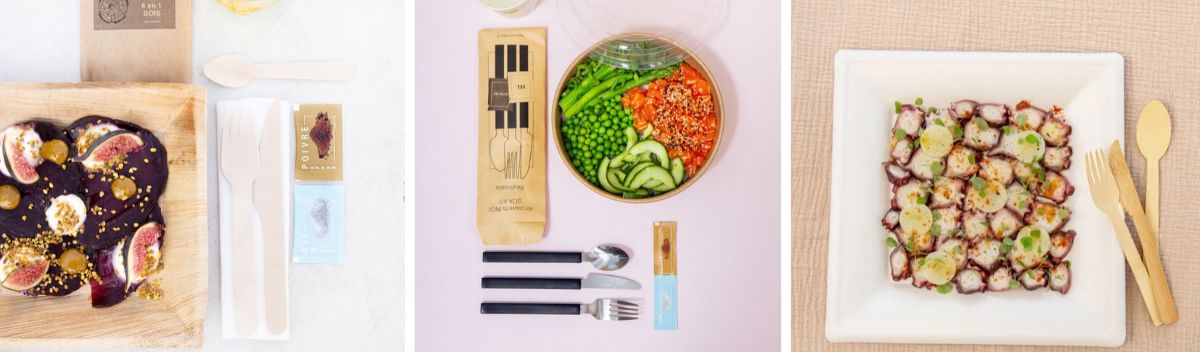
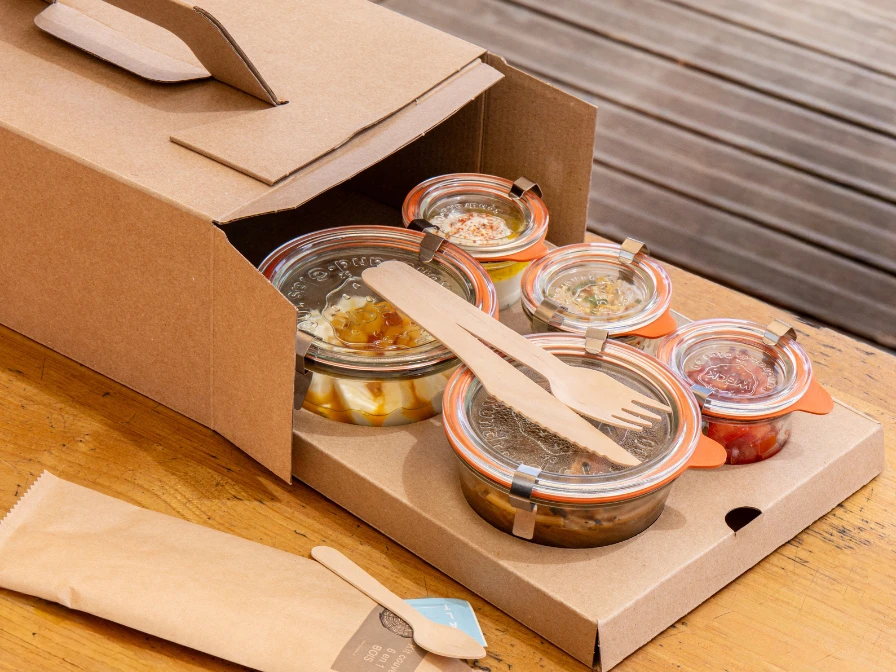
Cutlery kits combining a fork, knife and napkin in a paper sleeve make order preparation easier and improve hygiene. Depending on the meal, a spoon can also be included. A salad, a boxed meal or a meal tray may each require different utensils, so it is better to tailor the contents to the food rather than automatically providing the same kit every time.
A simple tip: offer cutlery on request rather than automatically including it in every bag. Adding a checkbox to your online ordering platform helps reduce waste and keep purchasing costs down.
Whether an order includes a cardboard box, a salad bowl or another type of food packaging, the principle remains the same: provide accessories according to actual needs. Loose cutlery or paper-wrapped sets, paper napkins, drinking straws or a small coffee spoon only include the items customers really need in each bag.
Cocktail parties, buffets and events
For events and receptions, presentation matters just as much as practicality. For canapés and verrines, mini wooden or bamboo cutlery and serving tongs make it easy for guests to enjoy bite-sized portions without needing a plate or knife.
For a seated dinner, stainless steel takes centre stage. Caterers providing event services often combine both options: bamboo for standing drinks receptions and stainless steel for seated meals, with careful stock checks when everything is returned.
The design of the utensils and how well they complement the serving trays also contribute to the overall quality of the presentation, right down to the choice of napkins and tasting spoons.
Order your cutlery from Comatec
Comatec supports food service professionals with a range of cutlery covering all three materials (wood, bamboo and stainless steel), as well as cutlery kits, mini cutlery and reusable tableware. To help you compare the environmental impact of each product, a PlanetScore© rating is displayed on every product page. The company's commitment has also been recognised with a Platinum EcoVadis Medal in 2026.
Before placing a bulk order, request your free samples to test rigidity, weight and finish under real service conditions. Also compare bulk and pre-packed options, packaging presentation and how well the design complements your range of food containers.
Delivery times and shipping costs are detailed in our delivery terms and conditions.
FAQ
Is wood suitable for occasional use?
Yes. Lightweight and affordable, wooden cutlery is designed for single use and is best suited to takeaway, delivery and buffet services. Choose a thicker design for dishes that require cutting.
Is bamboo cutlery really reusable?
Yes, but only if it is made from solid bamboo and washed by hand. It is suitable for smaller volumes and food service concepts where aesthetics take priority over speed and volume.
Why is stainless steel the go-to choice for dine-in service?
Because it is the only material that can withstand repeated professional dishwasher cycles over time. Its cost-effectiveness depends largely on keeping losses under control and maintaining accurate stock records. The durability of the cutlery alone is therefore not enough: proper stock management is also essential to keeping long-term costs under control.
Can bamboo cutlery go in the dishwasher?
No. Even when varnished, bamboo deteriorates when exposed to very hot water and the alkaline detergents used in dishwashers. It can crack, lose its finish and become difficult to clean properly. Stick to hand-washing bamboo cutlery and leave the dishwasher for your stainless steel cutlery.
What is the difference between 18/10 and 18/0 stainless steel?
C'est la teneur en nickel. Le 18/10 en contient 10 %, ce qui lui donne plus d'éclat et une meilleure tenue face aux taches. Le 18/0 n'en contient pas : moins cher, il attire les aimants et se prête bien aux services où le budget passe en premier.